Advanced lubrication technology backed by independent laboratory testing and real-world results
![[background image] image of auto parts](https://cdn.prod.website-files.com/6a859f13125d176bbd90fe5a/6a9eba134968cf30ba6c2f93_wide_cinematic_studio_industrial_close_up_scene_o.png)
Lower friction, heat and mechanical wear

![[background image] image of auto parts](https://cdn.prod.website-files.com/6a859f13125d176bbd90fe5a/6a89e5d210263e92acafd2ba_PB35-Formulated-With-Purpose-FIXED.jpg)
Independent laboratory testing. Real-world results.
UNDERSTAND THE PRODUCTWhat it is, how it works, and what the data shows
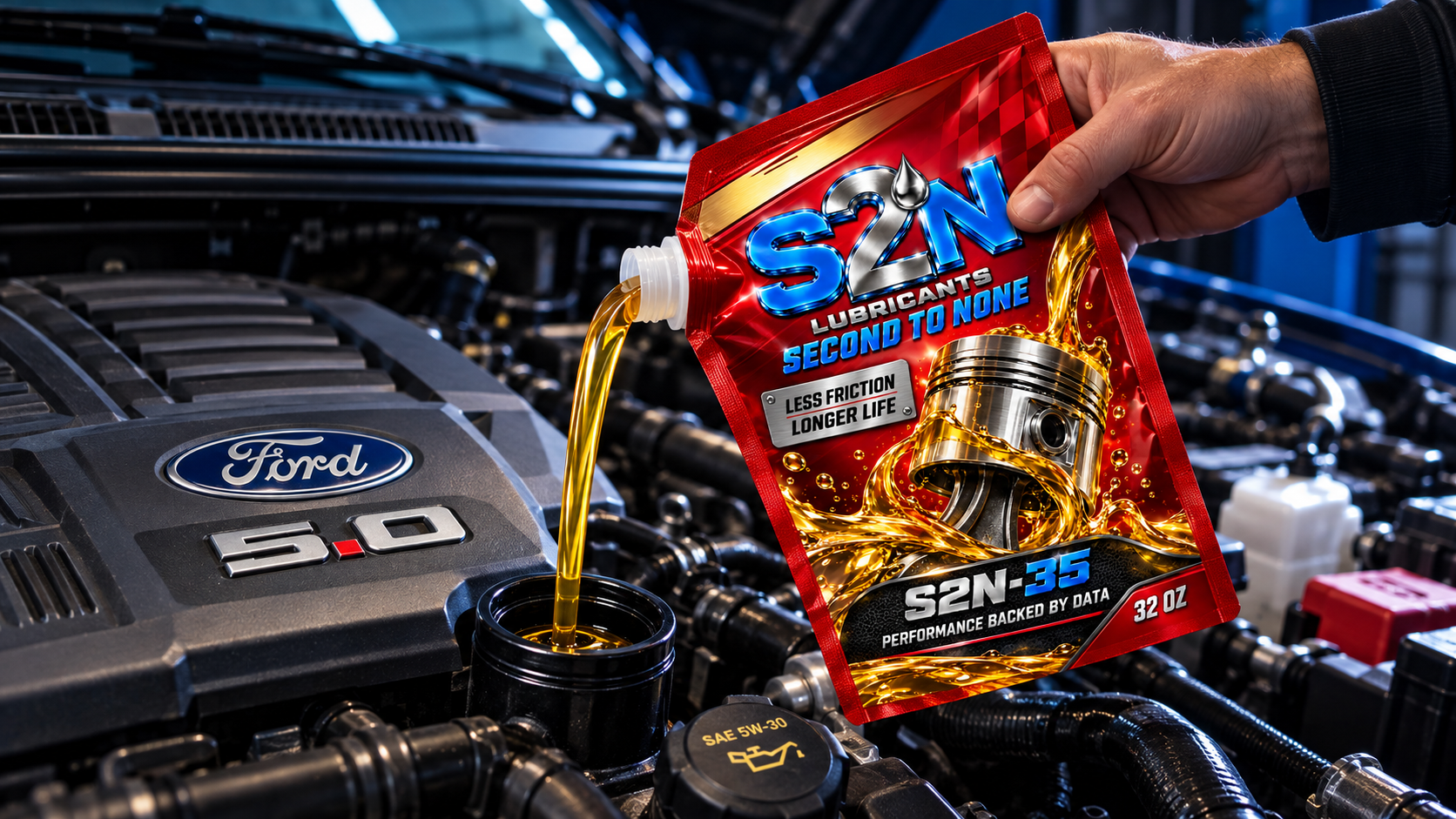
S2N-35 is a synthetic polymer-based engine oil supplement designed to replace a portion of the motor oil in an engine's crankcase. It works alongside conventional, synthetic-blend, and full-synthetic motor oils to reduce friction and wear while supporting cleaner, longer-lasting lubrication.

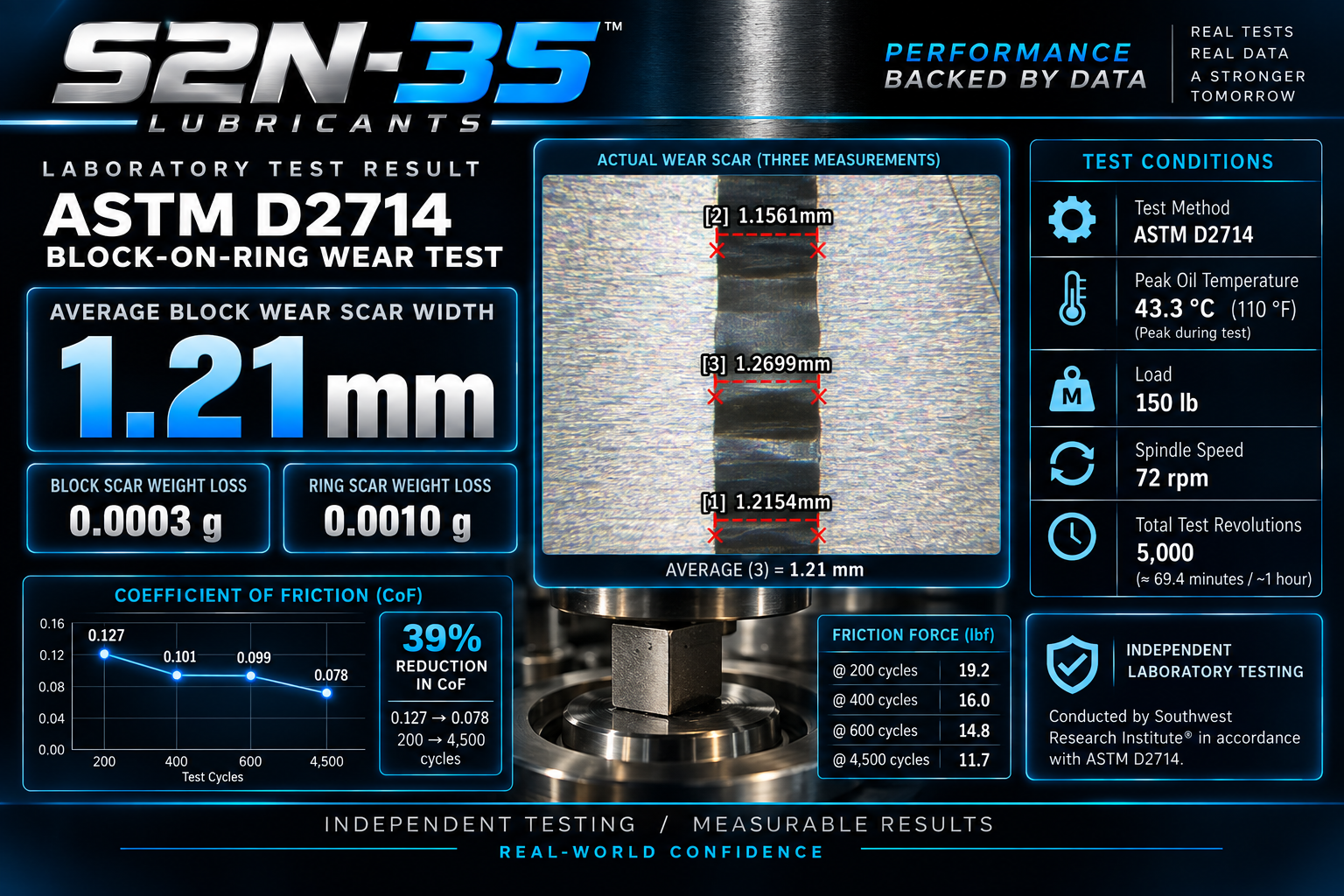
S2N-35 works alongside the remaining motor oil within the engine's lubrication system. In ASTM D2714 testing, the measured coefficient of friction fell from 0.127 at 200 cycles to 0.078 at 4,500 cycles—a 39% decline as testing continued.
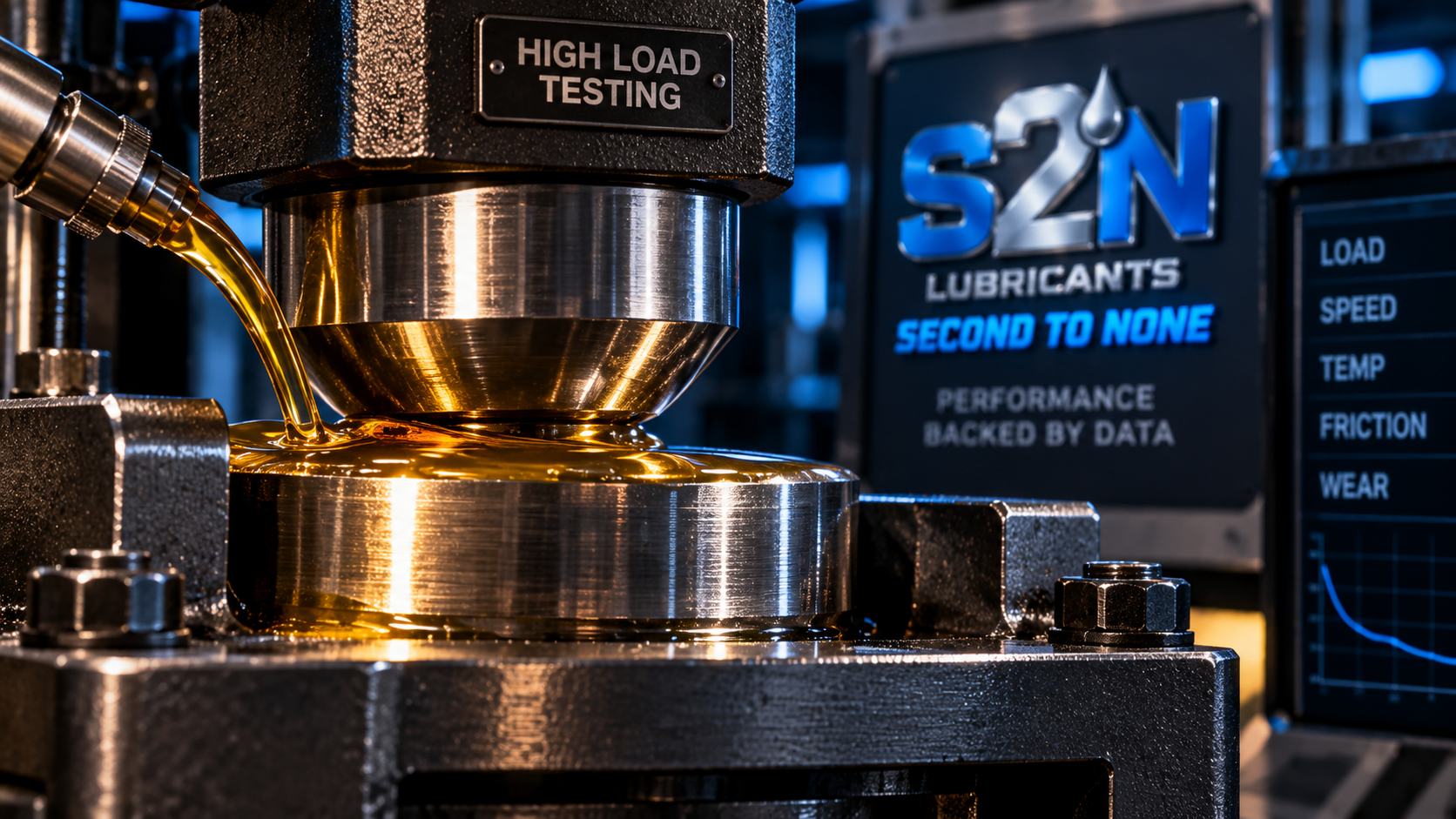
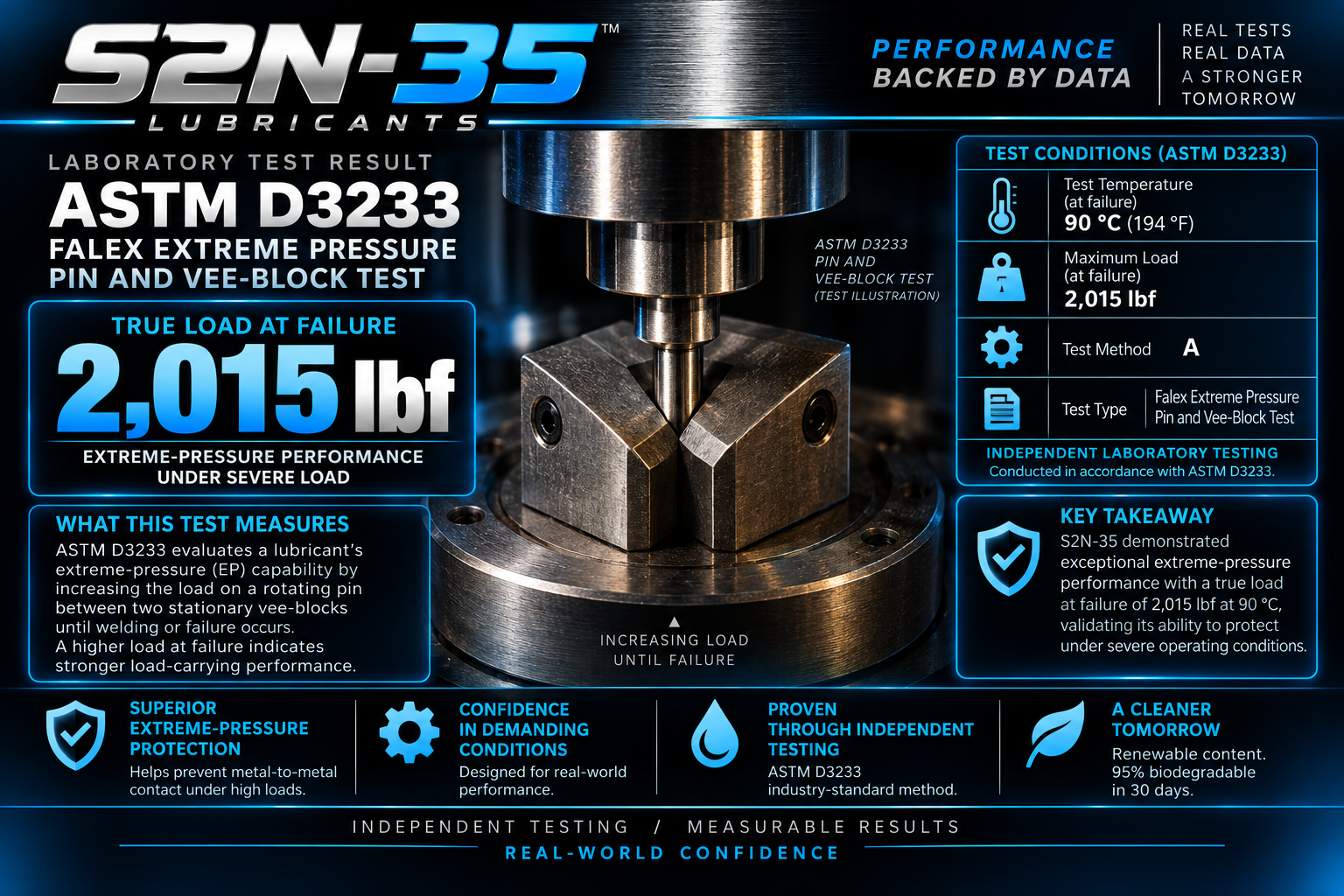
S2N-35 has been tested under demanding wear and extreme-pressure conditions. ASTM D3233 Falex testing reached a measured load of 2,015 lbf at failure. ASTM D2714 testing measured a 1.21 mm average wear scar under loaded sliding contact.
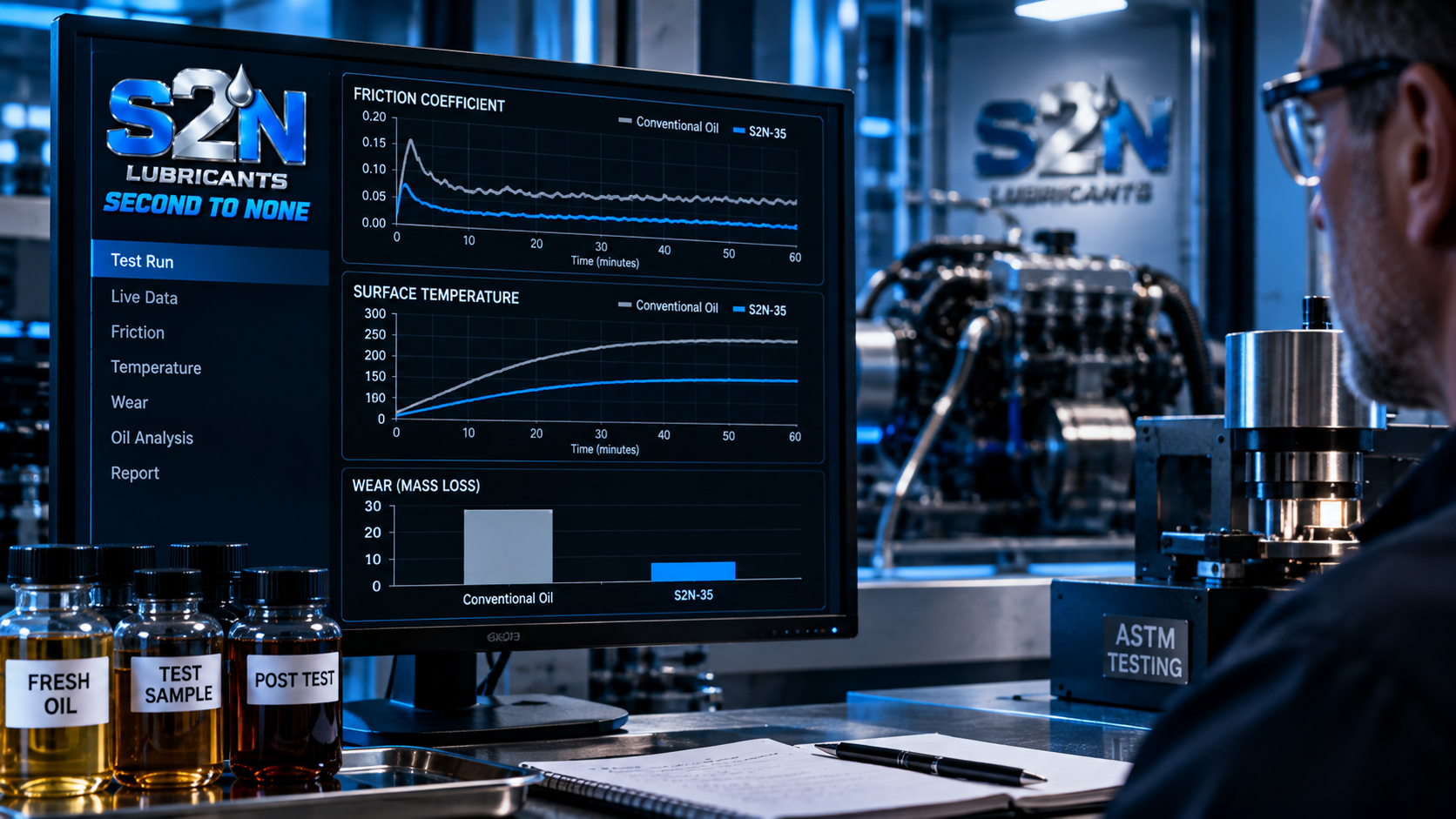
S2N-35 development continues through independent laboratory testing, field observations, used-oil analysis, and real-world vehicle testing. Lower treatment concentrations, reduced oil consumption, and other observations are documented and investigated as the evidence develops.
Laboratory testing backed by real-world oil analysis
Used-oil analysis can track wear metals, lubricant condition, and oil-life indicators during extended service.
ASTM D3233 Falex testing reached a measured load of 2,015 lbf at failure.
BEFORE S2N-35: Audible lifter tickAFTER S2N-35: Lifter tick not audible in this recordingReal-world field observation. Individual results may vary. This recording documents the observed change before and after S2N-35 treatment.
What owners have reported, what testing has measured, and why individual results can vary.
Some owners have reported quieter, smoother engine operation after adding S2N-35, including cases where previously audible lifter tick was reduced or no longer audible.
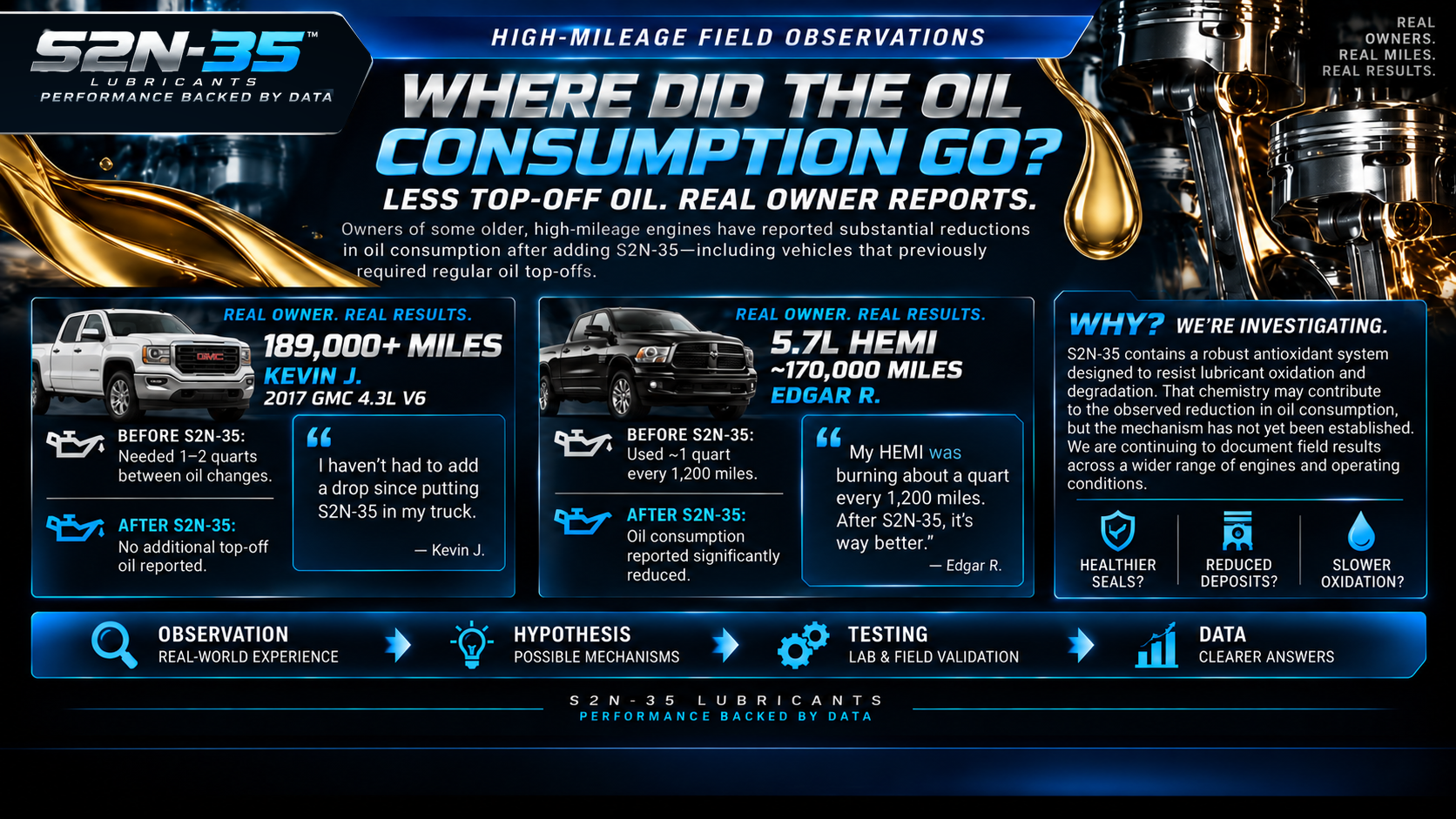
Some owners of older, high-mileage engines have reported reduced oil consumption after adding S2N-35, including vehicles that previously required regular top-offs. We are continuing to investigate why this occurs.
Some owners have reported improved fuel economy after adding S2N-35. MPG can also be affected by speed, driving style, traffic, terrain, weather, tire pressure, vehicle load, maintenance, and fuel formulation—so individual results can vary.
Independent laboratory testing has measured reduced friction, strong wear protection, and extreme-pressure performance with S2N-35. These controlled test results document lubricant performance; individual engine results can vary.
Every engine is different. Vehicle age, mileage, engine design, existing wear, oil formulation, driving conditions, maintenance, and treatment concentration can all influence what an owner observes. Some changes may be noticeable; others are better evaluated through mileage records or used-oil analysis.
![[background image] image of auto parts](https://cdn.prod.website-files.com/6a859f13125d176bbd90fe5a/6aad5f74e87a46bbe3d9dc12_a_high_resolution_cinematic_close_up_automotive.png)
READY TO PROTECT YOUR ENGINE?
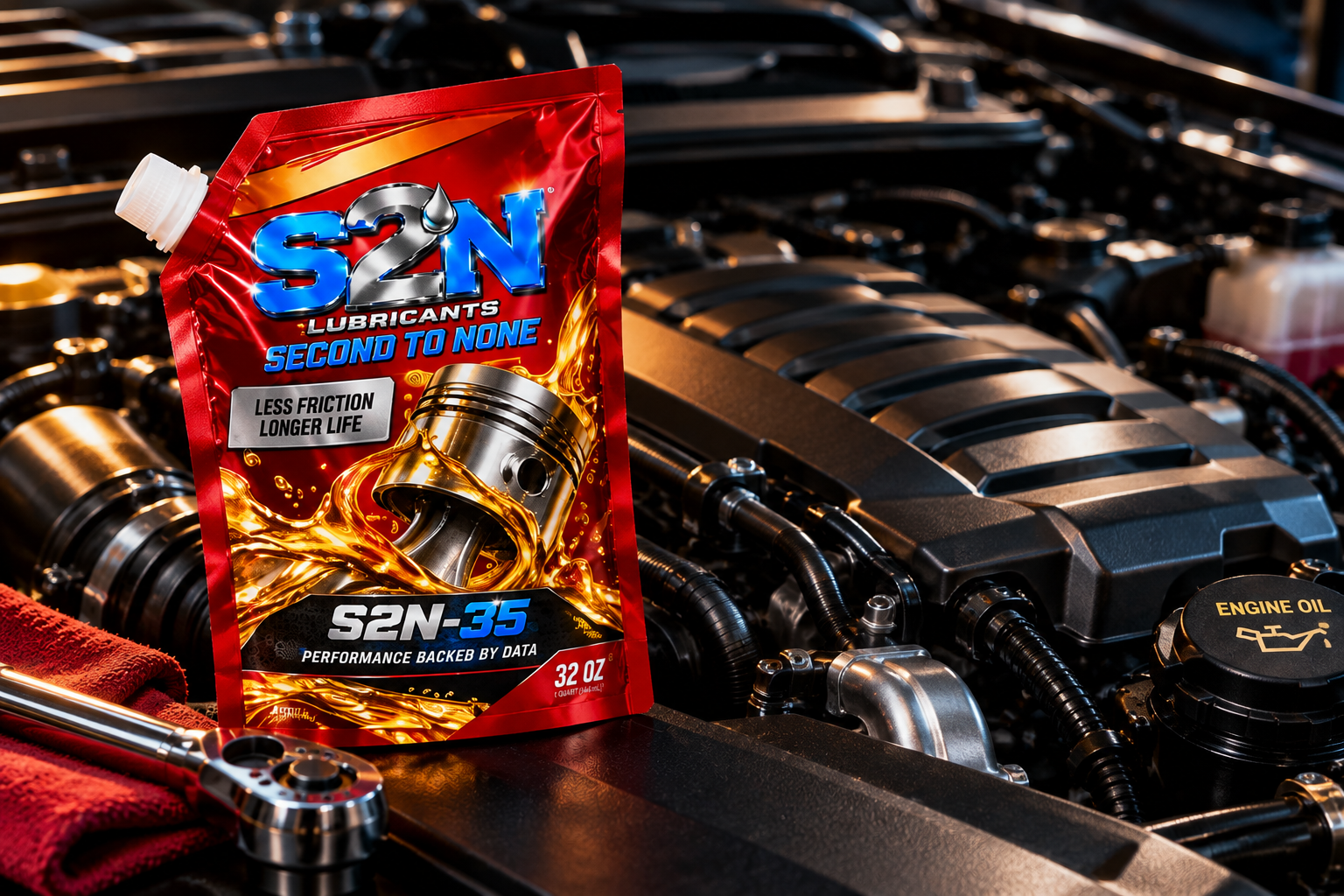
Replace a portion of the motor oil you already trust with S2N-35—engineered to reduce friction and wear where loaded metal surfaces meet.
Straight answers about using S2N-35
S2N-35 is a synthetic polymer oil supplement engineered to reduce friction and help protect metal surfaces inside gasoline and diesel engines. It replaces a portion of the engine’s motor oil and works alongside a compatible conventional or synthetic motor oil. Follow the product directions for the correct treatment amount.
S2N-35’s standard treatment is 35% of the engine’s total specified oil capacity. It replaces that portion of the motor oil—it is not added on top of a full crankcase.
For example, a 6-quart total fill uses 2.1 quarts of S2N-35 and 3.9 quarts of compatible motor oil.
Always follow the product directions and maintain the engine manufacturer’s specified total oil-fill level. Do not overfill the crankcase.
Yes. S2N-35 is compatible with conventional petroleum-based and synthetic motor oils. It replaces a portion of the motor oil in the crankcase.
Use motor oil that meets your engine manufacturer’s required specifications, and follow the S2N-35 product directions for the correct treatment amount.
Yes. S2N-35 can be used in turbocharged gasoline and diesel engines with the correct manufacturer-specified motor oil. Follow the S2N-35 product directions for your application.
Always follow your engine manufacturer’s requirements for oil viscosity, specifications, and maintenance intervals.
Yes. S2N-35 can be used in gasoline and diesel engines with motor oil appropriate for the application.
Always use motor oil that meets your engine manufacturer’s required viscosity and specifications, particularly in modern emissions-equipped diesel engines. Follow the S2N-35 product directions for your application.
Yes. The formulation now marketed as S2N-35 has undergone independent laboratory testing using multiple ASTM test methods.
Results include:
• ASTM D4172 Four-Ball Wear Test — 0.37 mm wear scar
• ASTM D4172 Used-Oil Challenge — 0.38 mm wear scar
• ASTM D2714 Block-on-Ring Test — 1.21 mm average wear scar
• ASTM D3233 Extreme-Pressure Test — 2,015 lbf true load at failure
We believe performance claims should be supported by measurable evidence. That's why laboratory testing, field observations and continuing data collection are central to S2N's product-development philosophy.
Performance Backed by Data.
Each test evaluates a different aspect of lubricant performance.
ASTM D4172 Four-Ball Wear Testing measures wear under controlled load, speed, time and temperature. S2N-35 produced wear scars of 0.37 mm and 0.38 mm in two different oil-base tests. Smaller wear scars indicate less wear under the conditions of the test.
ASTM D2714 Block-on-Ring Testing evaluates friction and wear between loaded metal surfaces. S2N-35 produced an average wear scar of 1.21 mm. During the test, the measured coefficient of friction decreased from 0.127 at 200 cycles to 0.078 at 4,500 cycles.
ASTM D3233 Extreme-Pressure Testing evaluates a lubricant's ability to carry increasing load before failure. The S2N-35 formulation reached a true load at failure of 2,015 lbf.
No single laboratory test can predict exactly what will happen inside every engine. Together, however, these tests provide measurable evidence of the formulation's anti-wear, friction and extreme-pressure performance under the conditions tested.
Owners have reported reduced or no longer audible lifter tick after using S2N-35, including in high-mileage HEMI engines. The reported timing and degree of improvement varied between vehicles. Follow the product directions for the correct treatment amount.
Improved fuel economy has been reported in real-world S2N-35 use, but results vary by vehicle, engine load, driving conditions, and driving style. Fuel-economy improvement is not guaranteed.
S2N continues to collect and evaluate these field observations.
To evaluate your results, establish a fuel-economy baseline before treatment and compare multiple tanks before and after treatment under similar operating conditions.
Yes—especially if you plan to extend your normal oil-change interval.
Used-oil analysis provides objective information about the condition of both the lubricant and the engine. Depending on the analysis performed, it can measure factors such as viscosity, wear metals, contamination, oxidation, fuel dilution, water, coolant indicators, and remaining alkalinity (TBN).
S2N-35 may help a lubricant perform under demanding conditions, but we do not recommend extending an oil-change interval based on mileage alone. Oil condition should be verified with laboratory analysis before substantially extending service intervals.
For commercial fleets and customers interested in extended drains, S2N strongly encourages establishing a baseline oil analysis and then sampling at planned intervals to follow trends over time.
Measure it. Track it. Follow the data.
Still have questions? Explore the evidence or give your oil the S2N-35 Advantage.